

by Jeff Bale
The origin of this blog post is a symposium organized by the Speech Axe: Harms of Language project on March 22, 2024.
I learned a great deal from the event. But one idea in particular has stayed with me. As we introduced ourselves that morning, most of us noted that we hadn’t chosen to study academic freedom or freedom of expression as part of our formal academic training.
Instead, these topics chose us.
Our own experiences with attacks on academic freedom and freedom of expression had led us to consider more carefully what these terms mean, where the boundaries between them lie, and which limitations they exhibit as ideals to guide political and scholarly activity.
At the time of this symposium, I was embroiled in my own conflict with a German university over the limits of academic freedom regarding Palestine solidarity. In fall 2023, I received a research fellowship sponsored by a consortium of universities in the German state of Nordrhein-Westfalen (NRW). My 6-month visit was scheduled to begin in September 2024.
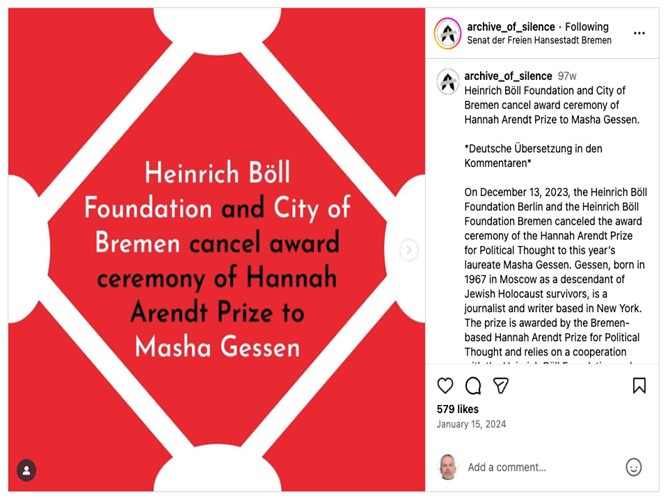
By the time of the Speech Axe symposium, I was already aware of attacks in Germany on Palestine solidarity. I address this in more detail below, but the conflict over an award to Masha Gessen and the police assault on a pro-Palestine demonstration at the Freie Universität, for example, had already made international headlines.
The first academic case I became aware of was that of Lebanese-Australian anthropologist Ghassan Hage. Hage had been dismissed from his research fellowship with the Max Planck Institute for Social Anthropology in Halle. On February 4, 2024, the conservative newspaper, Welt am Sonntag, attacked Hage on the basis of a poem he posted to his blog on October 7, 2023 and for this tweet from January 14, 2024. Welt denounced Hage as antisemitic and accused the Max Planck Institute of hiring “Israel haters.” Three days later, the Institute cut ties with Hage, stating: “Racism, Islamophobia, anti-Semitism, discrimination, hatred, and agitation have no place in the Max Planck Society.” (For an entertaining spoof of their statement, see here.)

With this growing record of silencing in Germany, I decided to have a closer look at the contract I had signed for my upcoming fellowship. §11(2) in particular caught my attention. The English version read:
“This contract can only be terminated for good cause … A good cause for termination is, in particular, if the fellow behaves in a way that seriously undermines the trust between themself and the College.”
This paragraph struck me as vague and one-sided: it neither defines “good cause” nor contemplates the potential for the College to behave “in a way that seriously undermines the trust between” it and me.
I therefore contacted the administrator of the fellowship program for clarification. In that email, I flagged the Hage case, the general climate of silencing in Germany with respect to Palestine solidarity, and cited §11(2) from my contract. I provided the administrator with links to my (then public) Twitter and Instagram accounts, as well as links to statements about academic freedom in the wake of October 7th I had co-authored as a vice president of my university’s faculty association.
My intent was to be transparent and to open a conversation about the forms of academic freedom I could expect while there. I was neither interested in spending my 6 months sparring with the university nor dragging my research partners there into a fight they did not ask for.
Weeks went by before I received a formal response, signed by the rectors of the three universities that sponsor the program and its director. The redacted text of that letter is shared below.


Since they requested a response, I provided one:

I open with this story, as it reveals many of the contradictions that have characterized the crisis around freedom of expression and academic freedom in Germany over the last two years: claims to the singularity of the German experience and the related assertion that ‘“outsiders” could never fully understand; and instrumentalizing legal and academic frameworks to limit speech and activity in the name of “open dialogue.”
The purpose of this blog post is to explore this contradiction and make some sense of the scale of repression we have seen in Germany. An obvious starting point might be that, as the perpetrator of the Shoah, Germany should be expected to be a staunch, even uncritical ally of Israel. While this response is logical at one level, it is also overly simplistic. For one, it flattens the complicated history of Germany’s relationship to Israel, in particular the historical production of its obsessive – and self-serving – loyalty to the Israeli state. For another, this answer ignores the internal racism an otherwise foreign policy animates, in particular the utility of “fighting antisemitism” for demonizing “migrants” and “Muslims.”
The Scale of Repression of Pro-Palestine Speech
Although this post is not meant to provide comprehensive documentation of the extent of attacks on pro-Palestine speech in Germany over the last two years, some context is helpful to make sense of the arguments I raise here.
Several journalistic, political, and scholarly accounts of these attacks have already appeared. One particularly helpful source is the Archive of Silence. The Archive began as a crowdsourced project on Instagram with a particular focus on cultural, arts, and media venues; it recently published its growing catalogue of repression as a website.
Their list as of December 19, 2025 included 248 reports of efforts to silence pro-Palestine speech. Of these, 54 occurred at post-secondary institutions and three in school settings, accounting for almost 25% of the incidents reported to them. This indicates that educational institutions have been an important battleground over what, if anything, is speakable about Palestinian freedom in Germany.
Of the many academic instances documented in the Archive, one in particular will likely resonate with North American scholars. In May 2024, the Federal Ministry for Education and Research initiated an internal review to determine whether it was able to cancel research funding for university staff engaged in critical speech or scholarship. The official justification was an open letter signed by over 1000 academic staff in Berlin, which critiqued the dismantling of the encampment for Palestine at the Freie Universität (the ironies speak for themselves here). When this effort to create a blacklist became public, the Minister for Education claimed to be unaware of it, even though she had publicly critiqued the open letter, questioning whether it had violated Germany’s constitution.
What stands out about the broader record of repression is the extent to which Germans – in almost all cases non-Jewish – have arrogated to themselves the right to stifle the pro-Palestine and/or anti-Zionist speech of Jewish people. I have already referred to two prominent cases in this post. The first is in my letter reproduced above, in which I discuss the cancellation of Nancy Fraser’s fellowship at the Universität zu Köln for having signed the Philosophy for Palestine open letter.
Masha Gessen’s case is also noteworthy in this respect. Gessen had been chosen for the 2023 Hannah Arendt Award for Political Thought. Between the announcement and the award ceremony, Gessen published their critique of memory culture and the erasures it allows. The Heinrich Böll Foundation, named after one of Germany’s most prominent post-war authors and affiliated with the Green Party (this detail becomes more important in a moment), sponsors the award but pulled out of the award ceremony. Their formal explanation was that, in response to Gessen’s essay, the Bremen government had denied access to the intended venue, therefore the ceremony was no longer possible.
Although Gessen ultimately received the award, one scholar noted in media coverage of this fracas, “Hannah Arendt wouldn’t get the Hannah Arendt award in Germany today.”
Another feature of this repression is the extent to which it violates the democratic ideals German laws claim to stand for. The attacks on the Palestine Congress in Berlin in April 2024 are a chilling example. The Berlin government used a series of maneuvers to shut down the event. Jüdische Stimme (Jewish Voice), a co-sponsor of the Congress, had their bank account frozen ahead of the gathering. The government prevented key attendees from entering the country, such as Dr. Ghassan Abu–Sittah, a Palestinian-British surgeon and rector of the University of Glasgow. In a post-pandemic world supposedly connected by videoconferencing, it further issued Betätigungsverbote (bans on political activity) to prevent participation in the Congress from outside Germany via Zoom. For the 800 people who did attend, they were confronted by some 2,500 police officers. An hour after the event began, the police raided the venue, cut off electricity, arrested the organizers, and forbade the Congress from continuing.
Some of these repressive acts – but not all – were later deemed to be unlawful. The police raid and dissolution of the event were ruled out of bounds. However, the court found that the Berlin government had acted appropriately in attempting to prevent the Congress as it was reasonable to believe that illegal speech made by identified hate groups would be present.
That is, the court endorsed a stance that pro-Palestine speech is always already guilty until proven otherwise.
Not only has the content of pro-Palestine speech been widely suppressed in Germany, but also the language(s) in which this speech is uttered. In February 2024, Berlin police began banning the use of Arabic on pro-Palestine demonstrations, demanding that only German or English be used. According to the police, they do not have enough speakers of Arabic among their ranks to determine whether chants, placards, and other uses of Arabic violated laws against hate speech.
That is, Arabic is always already guilty until proven otherwise.
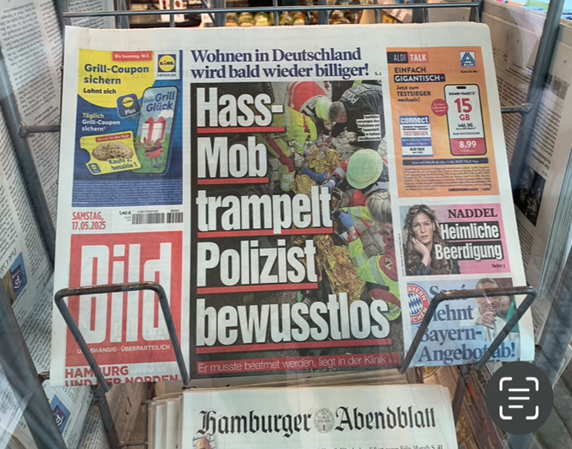
The police have also been physically violent on many occasions. At the Nakba Day protest in Berlin on May 15, 2025, the police were particularly abusive, but many news outlets turned that violence on its head and blamed the protestors. I happened to be in Germany at the time and took the picture below of the right-wing tabloid, Bild, and its “coverage” of the protest. The headline screams “Hate mob tramples police officer unconscious.” Not uncoincidentally, Bild is owned by Axel Springer Verlag, the same publisher as Welt am Sonntag, the newspaper that denounced Hage. This is another detail that becomes important later in this post.
These police claims about protester violence were later shown to be fabricated. However, as this commentary noted, the political damage was already done.
From Memory Culture to “Zionismus über Alles”
An obvious starting point to make sense of the scale of this violence and repression is Germany’s responsibility for the Shoah. Indeed, it is widely acknowledged that recognition of this responsibility has shaped Germany’s politics, culture, and collective imagination like no other historical event. However, the way Germany has confronted this responsibility and the lessons Germans have drawn have been anything but stable or unified.
For this section of my post, I draw largely on Hans Kundnani’s Utopia or Auschwitz and Daniel Marwecki’s Germany and Israel: Whitewashing and Statebuilding in particular, although I link to shorter articles by and interviews with the authors for readers to get a quicker sense of the arguments in their respective books.
Their analyses reveal key turning points in (West) Germany’s reckoning with the atrocities it committed under Nazi rule and the political conclusions drawn by social movements, political parties, and the German government.
A central contradiction of this reckoning as West Germany was founded in 1949 was the question of rehabilitation. For Western powers in particular, (West) Germany’s return to the international stage was vital for the fight against communism. However, Germany could not be considered a legitimate partner without atoning for the atrocities it had committed. Marwecki describes this process as one of “whitewashing” Germany’s reputation.
Reparations to Israel played a key role. Domestically, Marwecki notes that West German reparations created a major economic stimulus and were thus highly profitable. For Israel, they were existential: not only were German reparations central to modernizing the Israeli economy, but also Germany (along with France) was its main source of weapons. West Germany would remain the primary supplier of industrial, financial, and military aid to Israel until the Six Days War in 1967, after which the U.S. assumed that role.
Within West Germany, its founding chancellor, Konrad Adenauer of the conservative Christian Democratic Union (CDU), “had effectively suppressed any real engagement with Nazism.” This suppression was partly a function of allied occupation; the U.S. in particular was eager to rehabilitate Nazis and deploy them in the fight against communism. As one agent with the U.S. Army Counterintelligence Corps boasted:
They say, “[Why] did you use Nazis?” That is a stupid question. It would have been impossible for us to operate in southern Germany without using Nazis … [W]ho knew Germany better than anyone else. Who were the most organized? Who were the most anti-Communist? Former Nazis. Not to use them would mean complete emasculation. [1]
By the mid-1950s, many former Nazi leaders in the civil service, the judiciary, and the academy had been rehabilitated and returned to their positions. As one interviewee told Kundnani, many young people growing up in West Germany at that time felt they were “surrounded by Nazis”.
The structural continuity between the Nazi regime and the West German state was one of the key instigators of the so-called ‘68 generation of student protests. Their interventions laid the foundation for what has come to be known as Erinnerungskultur, or memory culture. For many in the ‘68 generation, this collective commitment to reckon with Germany’s crimes under Hitler also meant support for Israel, which many saw as a nascent socialist project.
Kundnani identifies two significant turning points in attitudes towards Israel among the ‘68 generation specifically and the German left more broadly. The first was a succession of events in 1967. On June 2, at a demonstration protesting the Shah of Iran’s visit to West Berlin, police killed a student protestor, Benno Ohnesorg. Parallel to this violence was the Six Day War brewing between Israel and a coalition of Arab states. The war itself broke out three days after Ohnesorg’s murder; media mogul Axel Springer would later brag about using his position to parrot Israel’s talking points during the war. Taken together, these events radicalized the student movement. Its perspective on Israel shifted, with many now seeing Israel as a bulwark for U.S. imperialism in the Middle East.
The second turning point was the hijacking of an Air France jetliner in 1976. The hijack was carried out by two Palestinians and two West Germans from the student movement in Frankfurt. The hijackers diverted the plane to Uganda, where they separated Jewish from non-Jewish passengers, releasing only the latter. The hijacking set two personal, but also politically consequential trajectories in motion. Benjamin Netanyahu’s brother was killed in the Israeli raid that freed the hostages, an event that Netanyahu would later cite as the beginning of his political life. As well, Joschka Fischer, future foreign minister of Germany in the 1990s, knew one of the hijackers, Winfried Böse. Fischer had been a member of Revolutionary Struggle, a Maoist grouping in Frankfurt, where he had known Böse from the left scene. He would later cite the hijacking as cause to rethink many of his political positions, including his stance on Israel.
By 1982, when Israel invaded Lebanon, Fischer had already begun his “long march” away from far-left politics, joining the formally anti-war and anti-nuclear Green Party. He defended Israel against Green critiques of the invasion it led, an early articulation of his perspective on the implications of Naziism for contemporary German foreign policy. In 1985, to mark the 40th anniversary of the end of World War II, Fischer wrote a commentary for Die Zeit, a prominent German weekly newspaper, arguing: “The essence of West Germany’s Staatsräson [national interest or raison d’état] cannot be the Western coalition, but solely German responsibility for Auschwitz. Everything else comes second” (translation mine). As Kundnani concluded, “Fischer sought to deduce a vision for German foreign policy from the principle of responsibility for the Holocaust.”
That principle was supporting military intervention to prevent genocide. Over a decade later, when Fischer was foreign minister as part of a coalition government between the Social Democrats and Greens, he would lead the charge for military intervention to prevent ethnic cleansing in Kosovo. Under the slogan “never again Auschwitz,” Fischer provided political cover for the first deployment of the German military since World War II, with four German fighter jets participating in the NATO bombing of Serbia.
Although Fischer first wrote about the centrality of the Shoah to Germany’s Staatsräson in 1985, it was the CDU’s Angela Merkel who succeeded in transforming this position some twenty years later into a consensus across the political spectrum. In 2008, Merkel gave a speech to the Israeli Knesset – the first German chancellor to do so – to mark the 60th anniversary of the Israeli state. She argued:
Every government and every chancellor before me has been committed to Germany’s specific historical responsibility for Israel’s security. This historical responsibility of Germany is part of the Staatsräson of my country. (translation mine)
As Kundnani argues, Fischer formulated this principle in general terms: for him, “never again Auschwitz” equated to the prevention of genocide everywhere. Merkel, by contrast, helped telescope this stance to mean uncritical support – financially, militarily, and politically – for Israel.
Nevertheless, it is the Green Party that has been particularly aggressive in maintaining this unwavering commitment to Israel. A coalition government of the Social Democrats, Greens, and Free Democrats was in power when Hamas attacked Israel. Once again, a Green politician, Annalena Baerbock, was foreign minister. Baerbock was among the loudest supporters of Israel, in particular defending Israeli atrocities and denying claims that it is conducting genocide in Gaza.
Informing, or perhaps enforcing, uncritical support by Germany’s political establishment for Israel are the interventions of the Springer media corporation. I have already referred to two such interventions above: the denunciation of Hage in Welt am Sonntag and falsely accusing demonstrators of violence in Bild. Kundnani offers his own list of witchhunts carried out by Springer publications, but notes the particularly chilling words of Springer chief, Mathias Döpfner. In April 2023, Die Zeit published an investigative report based on leaked emails written by Döpfner. In one of the emails, he discusses his political beliefs, proclaiming: “Zionismus über alles. Israel is my country.”
To be sure, Baerbock’s speeches are as disturbing as Döpfner’s emails. But the point is the devastating material consequences they have. Germany has long been the second-largest arms supplier after the U.S. Although it briefly paused weapons sales in 2024 when the reality of Israel’s genocide became undeniable, Germany resumed sales after the latest ceasefire was announced in October 2025.
From Memory Culture to Anti-Muslim Racism
Critical commentary on memory culture and its transmogrification into “hyper-Zionism” and “philosemitic McCarthyism” usually stresses the self-serving, even narcissistic nature of Germany’s uncritical support for Israel. Yet, the critique itself is often trapped inside the same loop: despite identifying the cynical way atonement for Auschwitz has become central to Germany’s national identity and interests, few critics are able to see beyond white Germans and Jewish people (whether in Germany or in Israel) as the main actors in the analysis.
Indeed, the few references in these critiques to “demographic changes” in Germany underscore this point (see here, for example). Sometimes, this term introduces the question of what memory culture can possibly mean to young people, who are now several generations away from anyone directly involved in the atrocities Germany committed during World War II.
But notice how the question takes for granted their membership in the category of white, ‘ethnic’ Germans. In a different context, artist Moshtari Hilal and political geographer Sinthujan Varatharajah have mocked this assumption by referring to “Germans with a Nazi background”, a play on the euphemism “Germans with a migration background” typically used to name migrants and their descendents in Germany.
At other times, critical commentary invokes “demographic changes” to refer to racialized and Muslim Germans so as to ask what memory culture should mean to them. Yet, this question – posed in debates about memory and history! – is itself ahistorical, ignoring the fact that it was largely migrants (then framed as guest workers) who rebuilt Germany after the war. Both usages rely on the constructed binary between insiders (i.e., “Germans with a Nazi background”) and outsiders (i.e., “Germans with a migration background”), which only has the effect of reinforcing the latter’s outsider status.
In her brilliant book, Subcontractors of Guilt: Holocaust Memory & Muslim Belonging in Postwar Germany, Esra Özyürek traces the historical construction of this exclusion and its consequences for Turkish, Arab, Muslim, and other racialized youth living in Germany today. Her argument centres on a key turning point in how racialized and Muslim people have been positioned in debates over memory culture and its central place in a modern German identity.
She writes:
[T]he exclusion of racialized groups from the foundational narrative of post-war German society was not a failure but rather a calculated effort: that is, founders and defenders of German memory culture, believing that only an ethnically homogeneous German identity could ensure German responsibility for the Holocaust, regarded racialized groups, such as the Muslim-background Germans who helped to build postwar Germany, as both external and irrelevant to the postwar public German narrative of democratization. As a result, Muslim-background Germans could not be included in the postwar German social contract, through which a new and free (West) German society was allowed by the Allies to emerge on condition of having learned the correct lessons from the Holocaust. (p. 1)
This exclusion began to shift in the early 2000s. Özyürek contextualizes this shift in a number of internal and external dynamics, including:
-
German reunification in 1990;
-
changes in the year 2000 to German immigration law facilitating citizenship for long-term residents;
-
the Second Intifada beginning in 2000;
-
major protests at that time against the Israeli state internationally and in Germany, home to the largest Palestinian community in Europe;
-
the September 11 attacks in the U.S. and the bombings in London on July 7, 2005;
-
the sharp rise in Islamophobia fueled by the “global war on terror”; and the consolidation of right-wing settler political movements in Israel (see pp. 13-16).